
End of Abyss is a top-down twin-stick shooter wrapped in Metroidvania gating and survival-horror pacing. Here is what to expect before you buy.
What Is End of Abyss? Twin-Stick Shooter or Metroidvania?
Both, and which one you notice first is the whole buying decision. End of Abyss is a top-down 3D twin-stick shooter where shooting happens every thirty seconds and Metroidvania gating happens every ten minutes — the shooting is what you do, the backtracking is what costs you time. That split is why four reviews published on the same day scored the same build anywhere from 6 to 90. Four dials decide whether that ratio works for you: the camera, the gating, the resource rules and the destination.
The one-line version
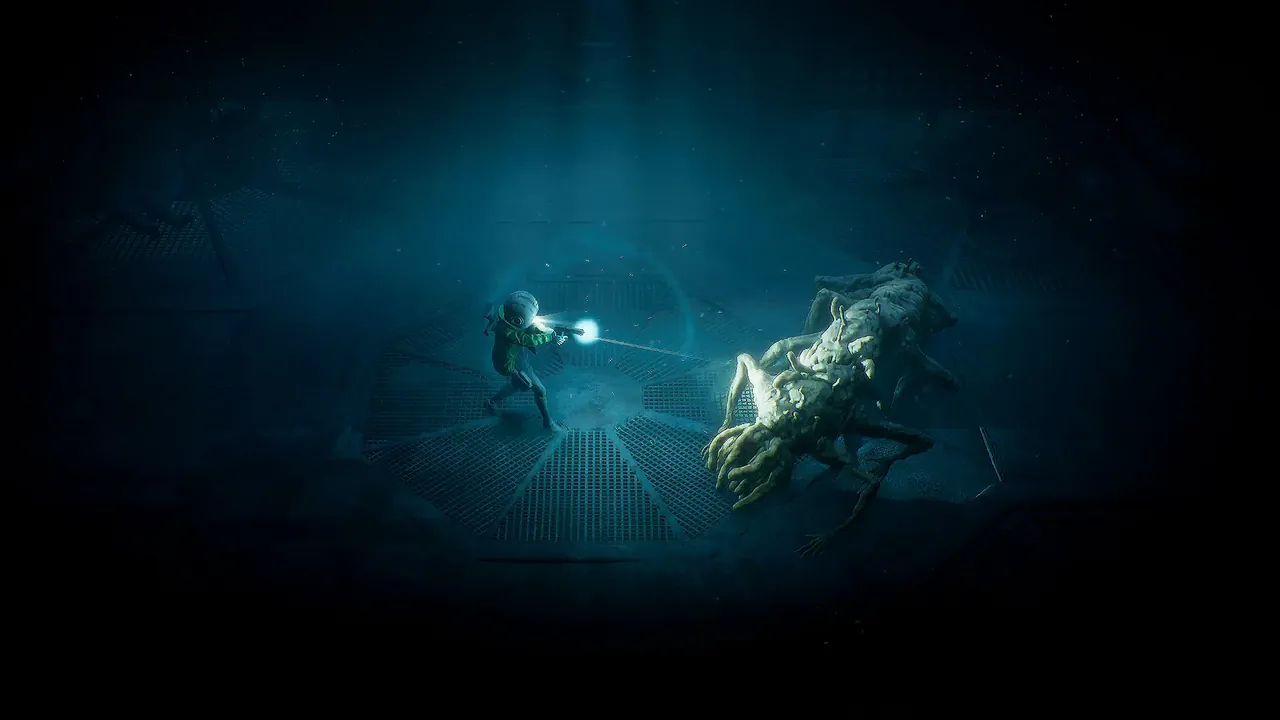
The most precise public description is Xbox Wire's, written at Summer Game Fest on June 19, 2026, five months before launch: "an atmospheric top-down 3D twin-stick shooter Metroidvania." One word per system, accurate about all three.
Official source: End of Abyss hands-on, Xbox Wire, June 19, 2026 — "an atmospheric top-down 3D twin-stick shooter Metroidvania," written after a demo playthrough at Summer Game Fest: Play Days.
It is a $29.99 single-player game from Section 9 Interactive, a three-person Malmö studio founded by former Tarsier Studios leads who worked on Little Nightmares and Reanimal, and published by Epic Games. It arrived October 1, 2026 for PS5, Xbox Series X|S and PC via the Epic Games Store. No Steam edition is listed as of October 3, 2026.
The camera: a 3D world played like an arcade twin-stick
You move with the left stick and aim 360 degrees around you with the right, against enemies that test your aim rather than a fixed firing arc. Xbox Wire notes the perspective is "pulled relatively far back," which is why Cel's spherical, old-diving-helmet silhouette reads clearly at that distance.
This is the strongest and least contentious part of the package. IGN called moment-to-moment combat "mostly strong" and said encounters "can swing drastically if you roll the wrong way or get caught in a corner." Expressiveness comes from layered inputs: hold fire on the pistol to charge a shot that temporarily drains your gun, tap grenade for a close toss or hold for distance.
Verbs stay small — dodge roll, aim, shoot, throw — and depth comes from the arsenal. Cel starts with the unlimited-ammo Pulse Gun and a knife; the shotgun, armor-piercing rifle, flamethrower and grenades are all finds. The weapons and ammo rules covers why that pistol changes everything else.
The progression: Metroidvania gates with a backtracking tax
The structure is real. Xbox Wire saw "a lot of classic Metroidvania on display: locked doors and keys, backtracking and shortcuts, scanning things to update your map." Shacknews framed it the way the genre predicts: "Like in a metroidvania, there's a lot of backtracking, as you'll often see locked areas that require a key or item that you don't yet have."
Gating is layered, not linear. Areas stack floors joined by ladders, anchor points, elevators, destructible walls and extendable bridges, so a locked door on F2 often means finding a route that starts two floors below. Elite areas demand Suit Mods you cannot equip until Suit Power is high enough — you cross the hazard before owning the tool that makes it survivable.
The tax is travel, not tedium. IGN: "Backtracking in End of Abyss is rough, even with a transit system that can take you to most zones. Cel does not move very quickly while sprinting." The seven shuttle stations covers which zones you can skip; the area and floor map covers the overlaps that make the walking disorienting.
Keys open doors. The scanner tells you they exist. Shacknews hit the d-pad on every crate, locked door and even enemies mid-chase; GamingTrend notes everything you scan gets labeled on your map. The scanner guide covers Energy Nodes and hidden paths.
The horror: resource discipline, not jump scares
This is where it borrows from Resident Evil and where it stops resembling it. Shacknews, piecing together derelict interiors, found "shades of classic Resident Evil." IGN's parallel was economic: "managing my Riot Breaker shotgun ammo and choosing to save my limited supply for the moments that mattered felt reminiscent of other survival horror games like Resident Evil."
The rules are strict and simple. The Pulse Gun has unlimited ammo; every other weapon needs ammunition crafted at workbenches inside safe rooms — the only places you can manually save. IGN found that after a couple of hours the materials to craft bullets "felt like drops in a bucket," so expect the tension strongest early and looser once your economy runs.
The jump scares were the least durable part. IGN: "What were once terrifying jump scares became predictable," because corpses holding items reliably turned out to be arena fights. Expect atmospheric dread, not sustained shock.
The goal: a one-way descent
You are Cel, a young combat technician dropped into a derelict underground facility with no crash course in what happened there. The place runs itself through AI boxes called Security Control Units, the staff have turned into Husks, and a voice on the network asks for help. The game is a spiraling descent: Outer Sector, Habitation Sector, Waterworks, Reactor Core, Containment Sector, then the Lower Levels.
That direction sets expectations. This is not a hub world you clear in any order — progress runs downward, floors overlap, returns go back up. If retracing steps to reach one new room grinds you, that is the deal-breaker. The Cel and story page covers what is knowable about the premise; the three SCUs and Central Elevator page covers the chain where players stall.
Who compares it to what, and where it breaks
Every reference point the press borrows is real, and each covers only part of the game:
| Comparison | Who makes it | What it actually maps to |
|---|---|---|
| Little Nightmares | Xbox Wire's headline; IGN on the "clay-doll aesthetic and isometric perspective" | Staff lineage, art, camera. Not the systems |
| Metroidvania | Xbox Wire, Shacknews, and GamingTrend's "quasi-metroidvania" | Keys, doors, shortcuts, backtracking. This one holds |
| Resident Evil | Shacknews on derelict interiors; IGN on shotgun ammo management | Resource tension and environmental storytelling. Not the camera |
| Dark Souls | GameSpot on restoration pods being "a save point and stand-in for Dark Souls' bonfires" | The save-and-reset loop only. Not the punishment |
| Metroid Prime | Game Informer compares the scanner to Metroid Prime's visor | One mechanic, not the shape of the game |
Not a Little Nightmares sequel, and not a soulslike
The comparison every headline makes is the one reviewer who played it hardest rejects. GamingTrend, having expected "the next iteration of Little Nightmares," writes that comparing them "isn't really fair," because this is "a much more fleshed-out experience, with a spiraling underground facility to explore, weapons to find and upgrade, ammo and items to craft, suit mods to find and equip, and bosses to defeat." What survives is "the familiar 2.5D view and the player being thrust into what feels like the middle of a story" — and "there is little else comparable."
The soulslike framing fails the same way. Restoration pods reset enemies like bonfires do, and GameSpot's headline complaint is that the horror evaporates once you have seen the loop twice. But the punishment model is absent: GamingTrend confirms "there is no penalty for death" beyond consumables already spent, and "there is no New Game+." A replay carries nothing over. The difficulty and death penalty page breaks down what dying actually costs.
All four reviews were published September 30, 2026, and GameSpot confirms a patch landed mid-playthrough. Section 9 has not published accessible patch notes, so verify navigation and bug behavior yourself.
Before you spend $29.99
Buy it if the atmosphere and audio matter most and you are the player who scans every crate and takes the long way back because the layering is the point.
Buy it for a short horror trip. Reviewers put the campaign at roughly 10 hours; the how long to beat breakdown separates story completion from a full Logbook clear.
Wait if you are buying it for combat variety. IGN found the boss fights "feel rote by comparison." If your references are Hades or Returnal rather than Metroid and Resident Evil, the shooting will feel thinner than you expect. The boss guide has the roster.
Then play the free Epic Games Store demo, the Xbox free trial, or the one-hour PS Plus Premium trial. For scores side by side, see the review roundup.
FAQ
What genre is End of Abyss? Officially "an atmospheric top-down 3D twin-stick shooter Metroidvania." In practice it is a Metroidvania with survival-horror resource management, and the shooting is the more developed half.
Is it a twin-stick shooter? Yes. Shacknews notes that although it is a 3D game, "it resembles a twin-stick shooter" in how you move with the left stick and aim with the right.
Is it a survival horror game? Partly. Ammo discipline, the safe-room economy and derelict interiors are survival horror. The jump scares are not.
Is End of Abyss a soulslike? No. It borrows the bonfire-shaped save loop but has no death penalty beyond spent consumables and no New Game+, as of the October 2026 launch build.
Is there a Steam version? None is listed as of October 3, 2026. PC is sold through the Epic Games Store only.
How long to finish? Media playthroughs put the campaign at roughly 10 to 13 hours. No official completion estimate has been published.
More End of Abyss Guides
End of Abyss has four Logbook categories, not one collectible list. Notes, Data Shards, Codes and Creatures each need a different sweep to reach 100%.
Where all 7 End of Abyss shuttle stations are, which sectors each one links, and why the shuttle network still cannot reach every area in the facility.
End of Abyss is a short descent: about 10-13 hours for the story, and considerably more to fill the Logbook, every Vault and every weapon to max.
End of Abyss spawns random invisible walls and a map that marks open doors as locked. What each bug looks like and how to get past it.
Every End of Abyss area and floor in one table: Outer Sector, Habitation, Factory East and West, Waterworks, Containment Sector, Lower Levels.
End of Abyss PC is Epic Games Store only. How to install and run it, which settings actually exist, and the answer on co-op and Steam.
The End of Abyss scanner is on the d-pad and it gates progression: it reveals Energy Nodes that open locked doors, hidden paths, and the map itself.
The exact End of Abyss progression chain: three power cores, three SCU overrides, the Central Elevator to Lower Levels, and every keycard on the way.